
Welcome to Lesson 2 of our Hebrew Literacy course! In this session, we’ll dive deeper into the science and research behind Hebrew literacy, exploring the complex processes involved in reading and how to support diverse learners. We’ll examine the debate between bottom-up and top-down approaches to literacy instruction and discover how integrating both methods can lead to more effective teaching. Get ready to gain a deeper understanding of the building blocks of Hebrew literacy and how to empower your students to become confident readers.
Bottom-Up versus Top-Down Literacy Approaches
There are two approaches to literacy learning: bottom-up and top-down. The bottom-up approach suggests that children must first learn letters, sounds, and words before developing reading skills. In contrast, the top-down approach emphasizes that children should learn about the world through experiences, stories, and activities, and then naturally develop literacy skills. However, the truth is that both approaches are necessary. Children need instruction in both bottom-up skills like phonics and top-down skills like comprehension and critical thinking. approaches to effectively support all learners.”

I like to use the analogy of the blind man and the elephant to illustrate this point. Just as the blind man must touch all parts of the elephant to understand its entirety, literacy educators must consider the full range of instructional frameworks.

The Scarborough’s Reading Rope
Let me show you Scarborough’s Reading Rope. This visual tool illustrates the comprehensive skills required for successful reading. The rope consists of two main strands:
- The bottom strand represents language comprehension, high-order thinking, vocabulary, background knowledge, and other top-down approaches.
- The top strand represents secretarial skills, such as phonemic awareness, decoding, and fluency, which are often associated with the bottom-up approach.
The key insight from Scarborough’s Reading Rope is that successful readers must weave both strands together, integrating both top-down and bottom-up skills to achieve proficiency. This visual aid helps me convey the big picture of Hebrew reading and the importance of a comprehensive approach to literacy instruction.

The Gateway to Hebrew Literacy
At Hebrew Scouts, we’ve created our own visual tool, the Gateway to Hebrew Literacy, inspired by Scarborough’s Reading Rope. We will explore how individual blocks of learning work together simultaneously and interdependently.
This integrated approach is crucial because many Hebrew literacy programs often focus on either the bottom-up or top-down approach exclusively. However, combining both approaches is essential for effective Hebrew literacy education.
In the US, there’s a common assumption that children can learn to read Hebrew without understanding the language. Yet, comprehension and language skills are vital components of Hebrew literacy, and that we should prioritize an integrated approach that combines both decoding skills and language understanding.
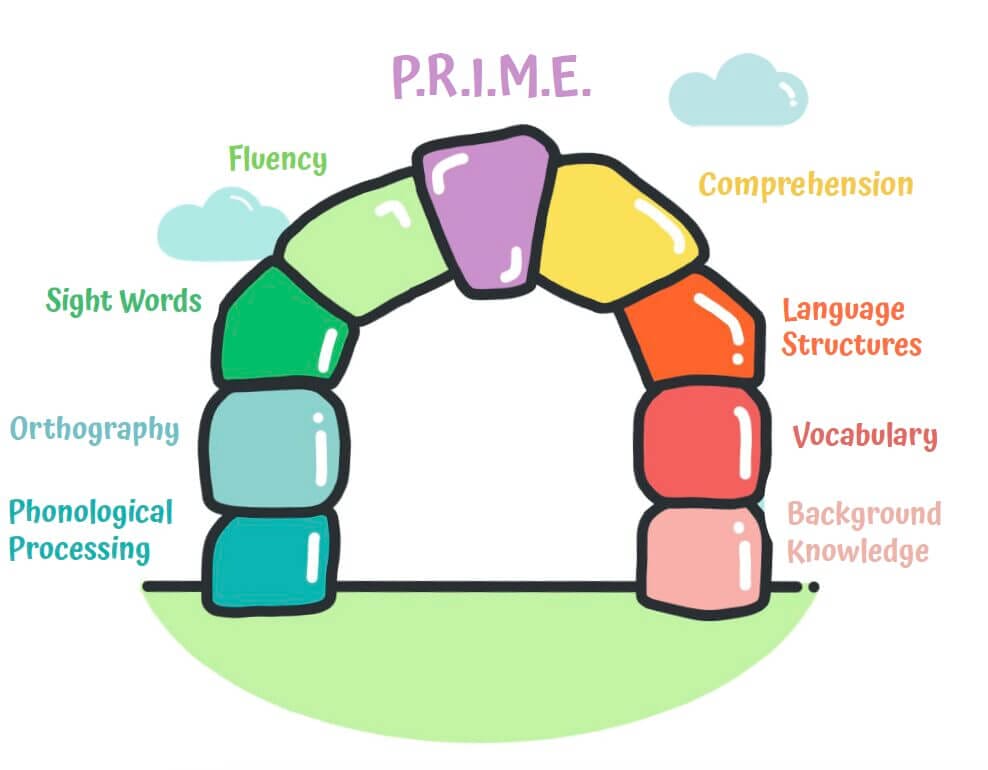
Drawing from my extensive background in literacy education and experience working with children, I can confidently attest that integrating language into literacy instruction has a profound impact on reading development. By combining language and literacy, we’ve consistently observed significant improvements in:
- Reading accuracy
- Reading fluency
- Stamina
- Engagement
- Intrinsic motivation
In fact, incorporating language into literacy doesn’t slow down the reading process; it actually accelerates it, catapulting students towards greater fluency and reading proficiency.
Why do some children have a hard time learning to read?
Let’s explore why some children struggle to learn to read despite attending classes year after year. We’ll examine two key factors: symbol imagery processing and phonological processing.
First, let’s define literacy and reading. When a child reads a word, they must:
- Recognize letters and vowels (symbols)
- Associate these symbols with speech sounds
- Blend sounds to form a word
- Connect the word to its meaning (concept)
For example, when seeing the letters “segol peh”, “patach reish”, and “chet”, the child must:
- Recall the sounds “peh”, “rah”, and “chet”
- Blend them to form “perach”
- Associate “perach” with the concept of a flower
Some children face challenges in:
- Symbol imagery processing: remembering symbols and attaching them to sounds
- Phonological processing: working with speech sounds to form words
- Concept processing: retrieving the ideas or concepts represented by words
Often, children struggle with one or multiple aspects of this process. To read successfully, all three processes must work together simultaneously. Let’s dive deeper into symbol imagery processing, phonological processing, and concept processing to better understand the complexities of reading.

The Reading Brain
To understand why reading processes can be challenging, let’s consider the intersection of literacy, culture, and brain function. Our brains weren’t designed to read text. Instead, we adapt brain areas meant for other functions to process symbols. For example:
- We use the visual processing area to interpret symbols, which can be a challenge for some individuals.
- We employ the language processing area to break down words into sub-parts (phonemes), which can be difficult for some children.
While some children naturally attend to component sounds, others need explicit instruction and support to develop this skill.

Symbol Imagery
Now, let’s consider the practical experience of a child in a classroom trying to learn alef bet and participate in reading exercises. What does it feel like for them to try to pay attention and keep up with their peers? Here’s a rewritten version of the text with improved clarity:
Let’s consider a child’s perspective on understanding the world. They see objects with characteristics like size and shape, such as a long snake or a fat snake. Naturally, they might apply this thinking to letters, wondering if a “vuv” should be long or wide.
However, letters work differently than objects. Children need to learn that letters are symbols with specific shapes and sounds, unrelated to physical characteristics like size or width. This understanding requires developing “symbol imagery processing” skills, which involve:
- Recognizing and remembering letter shapes
- Differentiating between similar-looking letters
- Understanding that letters represent sounds (syllables), not physical objects
This cognitive shift is crucial for reading and literacy development.

Hebrew Scouts was created because we understand the struggles of children with learning differences. Hebrew reading is a fundamental skill crucial for:
- Torah study
- Tefillah (prayer)
- Social participation
- Cultural engagement
The consequences of not being able to read Hebrew can be severe. I’ve seen individuals who couldn’t read Hebrew feel anxious and embarrassed, like the person who couldn’t read the Sheva Brachot at their sibling’s wedding. This inability can make years of school and Yeshiva challenging and painful.
We’re here to empower you with the tools to help every child succeed in reading Hebrew, right from the start. We’ve already made a positive impact and are committed to continuing our support.
