Why Do Some Children Struggle with Hebrew Reading but Not English—or Vice Versa?
It’s a question I often hear:
How can a child read English chapter books but struggle to decode simple Hebrew words?
Or how can a child manage Kriah reasonably well while struggling significantly with English reading?
Although reading difficulties often affect both languages, they don’t always appear to the same degree. Why is that?
What Does It Take to Read?
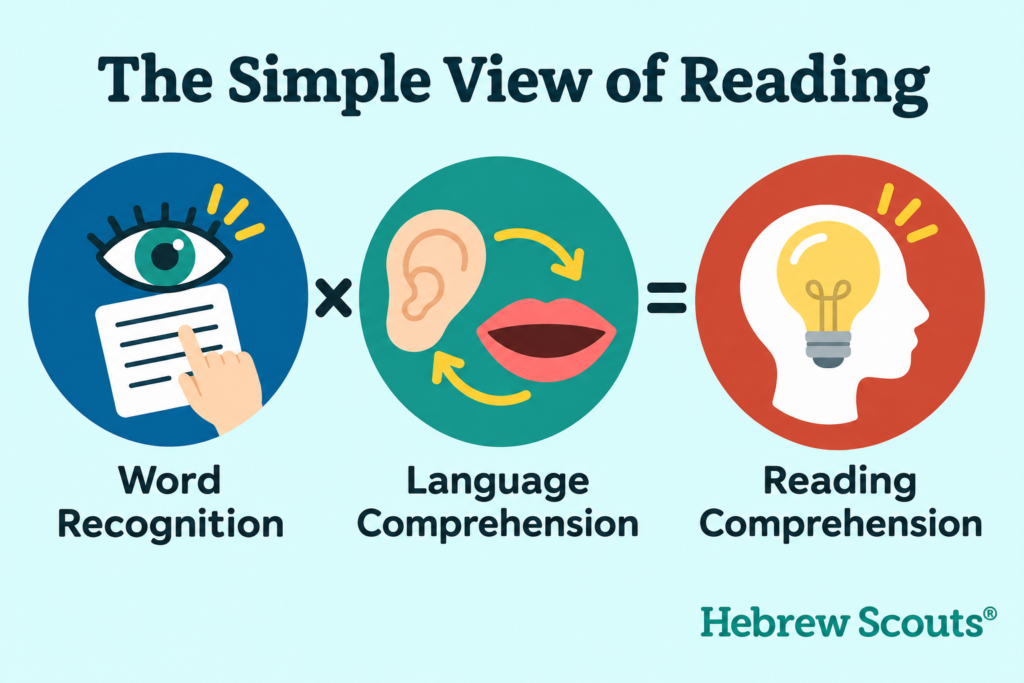
The Simple View of Reading helps us understand how a child’s unique reading profile may influence their progress in Hebrew and English. It identifies two essential skills that contribute to reading success: word recognition and language comprehension.
Word Recognition × Language Comprehension = Reading Comprehension
Word recognition involves decoding unfamiliar words and automatically recognizing familiar words. Language comprehension involves understanding vocabulary, sentence structures, and meaning.
Children may have different strengths and challenges in these two areas, but skilled reading requires both. This is true for Hebrew and English, even though the demands of developing these skills differ between the two languages.
Why Hebrew May Be Easier to Decode
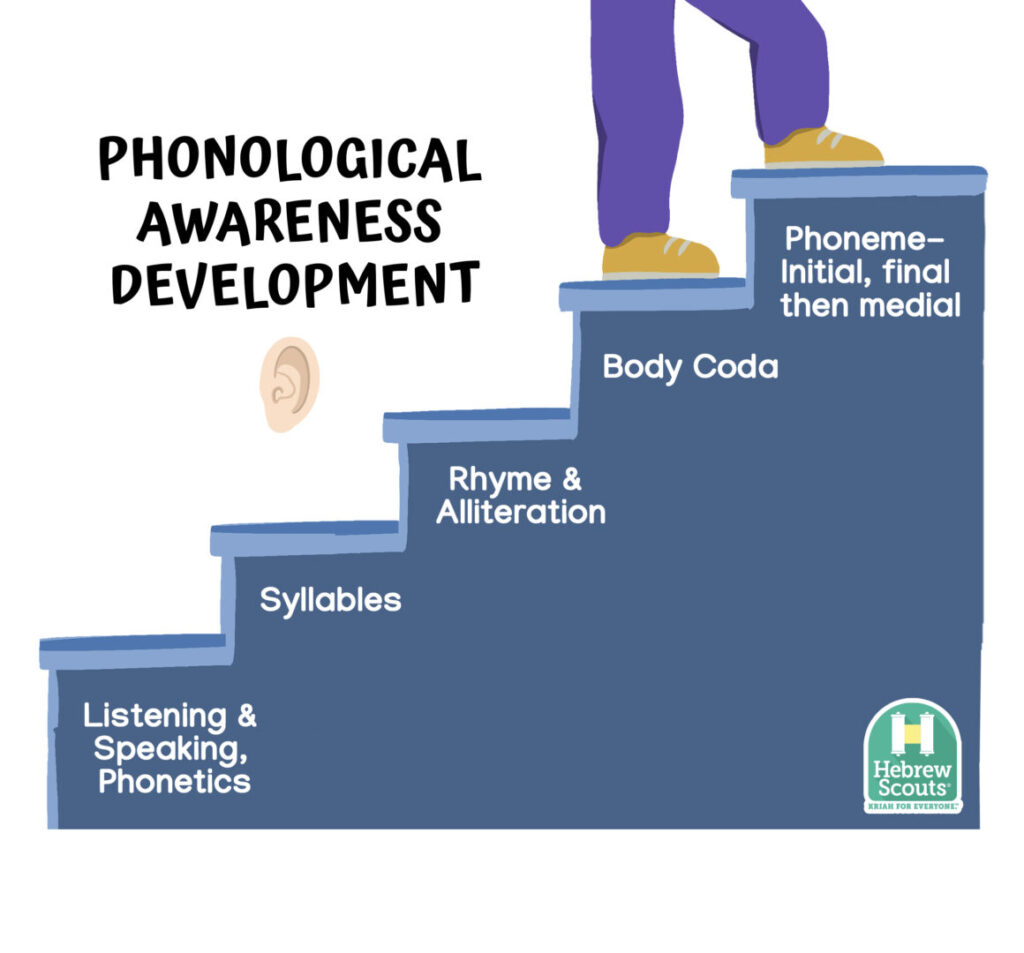
Learning to decode begins with recognizing the component sounds of spoken language, understanding how written symbols represent those sounds, and using these connections to read and spell words.
For some children, this process is challenging. They may have difficulty with phonological processing, recognizing and working with speech sounds, or with sound-symbol associations, connecting speech sounds with their written representations.
These difficulties can affect reading in both English and Hebrew. However, the two languages differ in ways that can make Hebrew decoding more accessible.
First, the writing systems differ in complexity.
English has a deep orthography, with numerous spelling patterns and overlapping sound-symbol relationships. A single sound can be represented by different spellings, and the same spelling can represent different sounds.
Consider though, through, and thought. Similar spelling patterns produce very different pronunciations.
Vowelized Hebrew, by comparison, has a relatively shallow, consistent orthography. Children learn a more limited set of letters, nikudot, and pronunciation rules that apply predictably across words. Once these patterns are mastered, children can apply them to a wide range of unfamiliar vowelized words.
For children who struggle to learn and recall sound-symbol associations, this consistency can reduce the demands of decoding.
Second, the languages offer different opportunities for blending sounds into words.
English instruction often requires children to blend individual phonemes, the smallest units of speech. For example, reading cat involves blending /k/ /ă/ /t/.
Vowelized Hebrew lends itself to instruction using larger sound units: syllables. Its consonant-vowel patterns allow children to learn pre-blended syllables and combine them into words, rather than having to blend every individual phoneme.
For children with limited phonemic awareness, blending syllables may be more accessible than blending individual phonemes.
Hebrew is not without challenges. Similar-looking letters and nikudot require careful discrimination. Nevertheless, its consistent orthography and opportunities for syllable-based blending can make Hebrew decoding more accessible for many developing readers.
Why Hebrew May Be Harder to Read
If Hebrew can be easier to decode, why do some children struggle with it more than English?
A major difference is language comprehension.
Most children learning to read English already speak and understand English. Their written language builds on an established foundation of oral vocabulary and language knowledge.
For many children learning Hebrew as a heritage or additional language, that foundation is much more limited.
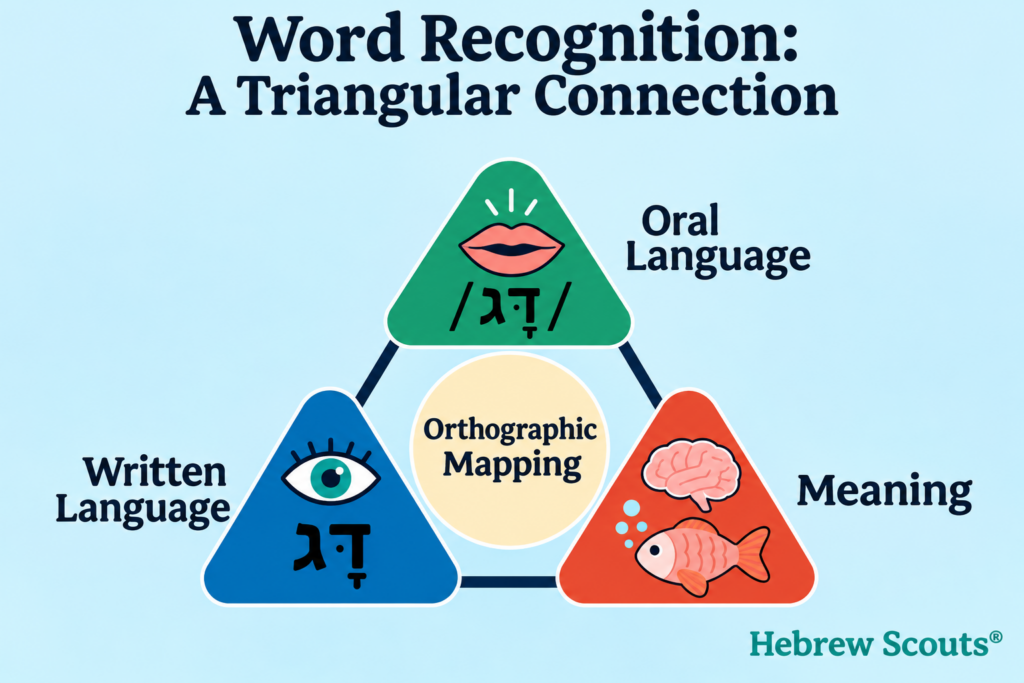
When children read words they already know from spoken language, they can connect print, pronunciation, and meaning. These connections reinforce accurate word recognition and support the development of sight words—words recognized automatically without deliberate sounding out.
Understanding what they read also helps children notice when something doesn’t sound right, reinforces successful reading experiences, and makes reading rewarding. Meaning encourages engagement, stamina, and the practice that strengthens reading skills.
But language knowledge can also mask weaknesses in decoding.
Some children with limited word recognition skills become overly dependent on vocabulary and context to identify words. Rather than recognizing words accurately, they work like detectives, using linguistic clues from surrounding words and sentences to figure out what a word might be.
These children may appear to read connected English text, yet struggle with isolated word lists, unfamiliar names, or spelling. They are using language comprehension to compensate for limitations in word recognition, rather than developing both skills to work together.
Now consider these children reading Hebrew.
If they have limited Hebrew vocabulary and are reading Tefila or Tehillim without understanding much of the text, they cannot rely on the same linguistic clues. Weaknesses in word recognition that were less apparent in English may become much more visible in Hebrew.
And even when children learn to decode Hebrew accurately, limited language knowledge can make it harder to develop efficient, meaningful reading. They may recognize written word forms, but without knowing the spoken words and their meanings, they have fewer opportunities to strengthen the connections between print, speech, and meaning that support skilled reading.
Of course, language differences are not the only factors. The amount and quality of instruction, opportunities for practice, and the emphasis placed on English or Hebrew literacy at school and at home can also influence children’s progress.
What Does This Mean for Hebrew Literacy Instruction?
Understanding these differences can help us design Hebrew literacy instruction that builds on the language’s strengths while addressing the challenges faced by additional-language learners.
- Phonological Processing: Make Word Blending Accessible
Take advantage of Hebrew’s syllable structure by teaching pre-blended syllables rather than requiring children to blend every consonant and nikuda separately.
Consider the English word cat and the Hebrew word בָּטָטָה (batata, sweet potato).
Although בָּטָטָה contains more written elements, children can read it by blending three familiar syllables: בָּ–טָ–טָ (ba–ta–ta). In contrast, cat requires blending three individual phonemes: /k/ /ă/ /t/.
For some children, combining three syllables is easier than combining three individual sounds. This illustrates how Hebrew’s structure can offer a more accessible entry point into word reading.
- Orthography: Build Mastery of Hebrew’s Predictable Code
Take advantage of Hebrew’s consistent spelling-to-sound relationships by explicitly teaching each pattern and providing enough practice for children to recognize and apply it automatically.
For example, when children are learning similar-looking nikudot, give them opportunities to master each one before practicing them together. This helps establish clear, reliable sound-symbol connections rather than allowing confusion to accumulate as new patterns are introduced.
- Sight Words: Connect Print, Pronunciation, and Meaning
Incorporate vocabulary instruction alongside decoding so children can connect written words with their pronunciations and meanings.
Repeated accurate reading helps words become automatically recognizable. Connecting those words to familiar spoken language and meaning strengthens the associations that support skilled reading.
- Language Comprehension: Build the Oral Language Foundation
Teach Hebrew vocabulary and familiar sentence structures alongside Kriah.
Rather than waiting until children can decode fluently to introduce meaning, give them opportunities to develop word recognition and language comprehension together.
- Meaningful Reading: Balance Reading for Meaning with Decoding Unfamiliar Words
Include familiar words, meaningful phrases, sentences, and stories so children experience the reward of understanding what they read.
At the same time, provide opportunities to decode unfamiliar words, including words outside their vocabulary, to ensure children can apply their reading skills independently rather than relying on memorization or contextual guessing.
6. Learning Sequence: Build on Strengths Across Both Languages
Consider the child’s learning profile when introducing Hebrew and English literacy. Children with phonological processing difficulties may benefit from beginning with vowelized Hebrew, where syllable-based blending can offer earlier success. In contrast, children with language or concept-processing difficulties, but relatively strong phonological skills, may benefit from first establishing literacy skills in their stronger spoken language.
In general, developing literacy in both languages in tandem can provide opportunities to build on the strengths of each language.
Understanding the Individual Reader
Every child brings a unique learning profile to reading. Understanding both the phonological, orthographic, and language demands of Hebrew and English—and a child’s abilities in each of these areas—helps us make sense of why reading progress may differ between languages.
Looking closely at a child’s phonological processing, sound-symbol processing, and language abilities, including in their first language, can help us identify underlying strengths and challenges rather than relying on reading performance alone.
The better we understand both the learner and the language, the better equipped we are to choose accessible instructional strategies and provide targeted support where it’s needed.