What is orthographic mapping in Hebrew? Why is it important? How do children achieve it?
The fundamental first task of learning to read is decoding. However, there are many additional skills that contribute to reading proficiently and fluently. Among these is sight word recognition. Sight words are words that individuals recognize on sight, instantly identifying them, knowing how to pronounce and spell them, and understanding their meaning. Sight words are like familiar landmarks in the reading landscape. Having lots of sight words speeds up reading, as readers don’t have to stop and sound them out letter by letter, vowel by vowel.
Orthographic mapping is the process that all successful readers use to recognize words by sight and become fluent readers. Through orthographic mapping, students use the oral language processing part of their brain to map (connect) the sounds of words they already know (the phonemes) to the letters in a
word (the spellings). They then permanently store the connected sounds and letters of words (along with their meaning) as instantly recognizable words, described as “sight vocabulary” or “sight words” (Sedita, 2020).

Having a large repertoire of sight vocabulary helps us read more rapidly and fluidly. Although Hebrew is mostly a phonetic language, meaning that the written letters flow more naturally and predictably from the way it is spoken, there are still some patterns and rules to become familiar with. Children don’t necessarily need to memorize words, as most words are decodable. Instead, they need to become familiar with the Hebrew orthography and patterns, including open and closed syllables, silent letters, the
rules of sh’va, and more.
Orthographic mapping is a crucial skill for reading Hebrew fluently and proficiently. By creating a mental map of words, connecting their spellings, sounds, and meanings, readers can decode unfamiliar words, recognize common words, and read with fluency.
The four phases described below are an instructional framework for Hebrew literacy informed by research on orthographic mapping, Hebrew orthography, and morphological development.

Phase 1: Decoding- Symbol Processing and Phonemic Awareness
In the first phase of orthographic mapping, students learn to process symbols, develop phonemic awareness, the ability to hear and manipulate individual sounds in words. They also recognizing that letter and vowel units represent sounds. This involves learning to blend these sounds to read words. For example, in Hebrew, the letters “kamatz, peh, kamatz, raish, and hey” combine to form the word “parah” ( פָּרָה), meaning “cow.” At this stage, children need to learn basic orthography rules, such as silent letters at the end of open syllables. Children process components of words by matching print to sound, blending the sounds into words, and then retrieving the meaning.
Phase 2: Orthographic Mapping of Sight Words
In the second phase, students begin to map sight words orthographically. This involves automatically recognizing the visual spellings of words all at once, and connecting them to words and the word’s meaning. For example, the Hebrew word “parah” (פָּרָה) can be processed instantly, without needing to process the word syllable by syllable or apply other rules. This process requires repeated exposure to the words in meaningful contexts, such as reading texts, playing games, and engaging in conversations. Through this repetition, students develop a mental map of the word, connecting its spelling, sound, and meaning.
Phase 3: Morphemic Awareness and Orthographic Mapping
In the third phase, students develop morphemic awareness, recognizing prefixes, suffixes,
and root words. They learn to use this knowledge to recognize unfamiliar words. For example, the Hebrew word “parot” ( הפרות) can be broken down into its component parts, including the prefix “ha-” ( ה), the root word “parah” ( פָּרָה), meaning “cow,” and the suffix “-ot” ( ות) indicating plural. At this stage, children will also need to learn spelling patterns, such as that the hey gets dropped when adding the sufiix vov-tav. By recognizing these component parts, students can use their orthographic mapping skills to recognize the denser word and understand its meaning.
הפרות

Phase 4: Recognizing Words Without Vowels
In the fourth phase, students learn to recognize words without vowels. This involves relying on their vocabulary knowledge and the context to recognize words. For example, the Hebrew words “tsipor” (ציפור), meaning “bird,” or “ari” ( אריה), meaning “lion,” can be recognized without vowels, using the consonantal skeleton and the context to determine their meanings. By working through these phases, readers can become more proficient and confident in their ability to read Hebrew texts, even when vowels are not present.
Transliteration and Orthographic Mapping
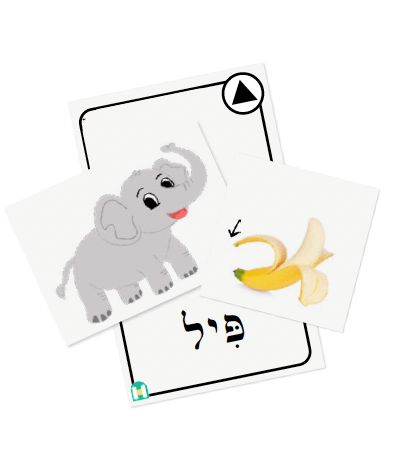
Using English words to practice Hebrew orthography, such as reading פיל as “peel,” may interfere with orthographic mapping. When children read the Hebrew word פיל, we want them to immediately think of an elephant, not the peel of a fruit. Orthographic mapping is strongest when written words are consistently connected to their pronunciation and meaning. By using English words, we may create competing associations rather than helping children build direct connections between Hebrew print, Hebrew pronunciation, and Hebrew meaning. In contrast, introducing Hebrew vocabulary and meaningful reading experiences from the start helps children develop stronger connections between a word’s spelling, pronunciation, and meaning, supporting more accurate and automatic word recognition.
Bibliography
Ehri, L. C. (2005). Learning to Read Words: Theory, Findings, and Issues. Scientific Studies of Reading, 9(2), 167–188.
Ehri, L. C. (2020). The Science of Learning to Read Words: A Case for Systematic Phonics Instruction. Reading Research Quarterly, 55(S1), S45–S60.
Schiff, R., Rosenstock, S., & Ravid, D. (2020). Morpho-Orthographic Complexity in Affix Spelling in Hebrew: A Novel Psycholinguistic Outlook Across the School Years. Frontiers in Psychology, 11, 868.
Sedita, J. (2020). The Simple View of Writing. (You already cite Sedita in your article for orthographic mapping terminology, and her practitioner work synthesizes Ehri’s research.)



